OP-ED | South Africans Have Waited Long Enough For Front-Of-Pack Warning Labels

In April 2023, the National Department of Health published Draft Regulation R3337, proposing changes to the way foodstuffs are labelled and advertised in South Africa, including the introduction of prominent front-of-pack warning labels on certain products high in sugar, sodium and saturated fat.

More than three years later, South Africans are still waiting for these regulations to reach the finish line.

Three years is a considerable period in public policy, particularly when the policy in question concerns a preventable contributor to the country’s growing burden of non-communicable disease. During this time, the evidence supporting clearer food labelling has continued to grow internationally, while South Africa’s proposed regulations have remained caught in a lengthy process of consultation and negotiation. 

The country now needs to move from deliberation to implementation.

We have been debating this for long enough

The case for front-of-pack warning labels did not begin with the publication of R3337. South African researchers have spent years examining how consumers understand nutrition information, which warning-label designs are most effective and how such measures could work within the South African food environment. 

The proposed system has therefore emerged from a substantial body of local research, public consultation and policy development rather than being an intervention introduced without consideration of its potential consequences.

There is also considerable international experience to draw upon. Countries including Chile, Mexico and Argentina have introduced front-of-pack warning labels, while the World Health Organization has recognised interpretive front-of-pack labelling as an important policy measure for helping consumers identify products with excessive amounts of nutrients of concern. 

Evidence from countries that have implemented these systems indicates that warning labels can improve consumers’ understanding of the nutritional quality of products and can create incentives for manufacturers to reformulate products to avoid receiving warnings.

South Africa should continue to consider legitimate questions about how the regulations will operate in practice. However, after years of research, consultation and policy development, the central issue should now be how the regulations can be implemented effectively rather than whether the country should continue debating the principle of clearer food labelling.

NEDLAC must help decisions move forward

This is where the current process involving the National Economic Development and Labour Council (NEDLAC) becomes particularly important. NEDLAC has an important constitutional and institutional role in South Africa’s system of social dialogue, bringing together government, organised business, organised labour and community constituencies to consider policies with significant socio-economic implications.

This op-ed was published on Health-e on the 8th of October 2026. Click here to read the entire article.

WE ARE HIRING: Non-Executive Board Member: Finance and Human Resources

We are seeking a Non-Executive Board Member with strong expertise in finance, human resources and/or organisational governance to join the HEALA Board. You will share the Board’s formal legal and fiduciary responsibility for the organisation and play a key role in strengthening the Board’s oversight of financial management, people and organisational governance as a member of the Finance and/or Human Resources Committee. 

This role is particularly suited to a senior professional with experience across finance, human resources and governance who is motivated by food justice, ethical leadership and the opportunity to contribute their expertise at Board level to a mission-driven organisation. 

HEALA launches countdown demanding approval food warning labels

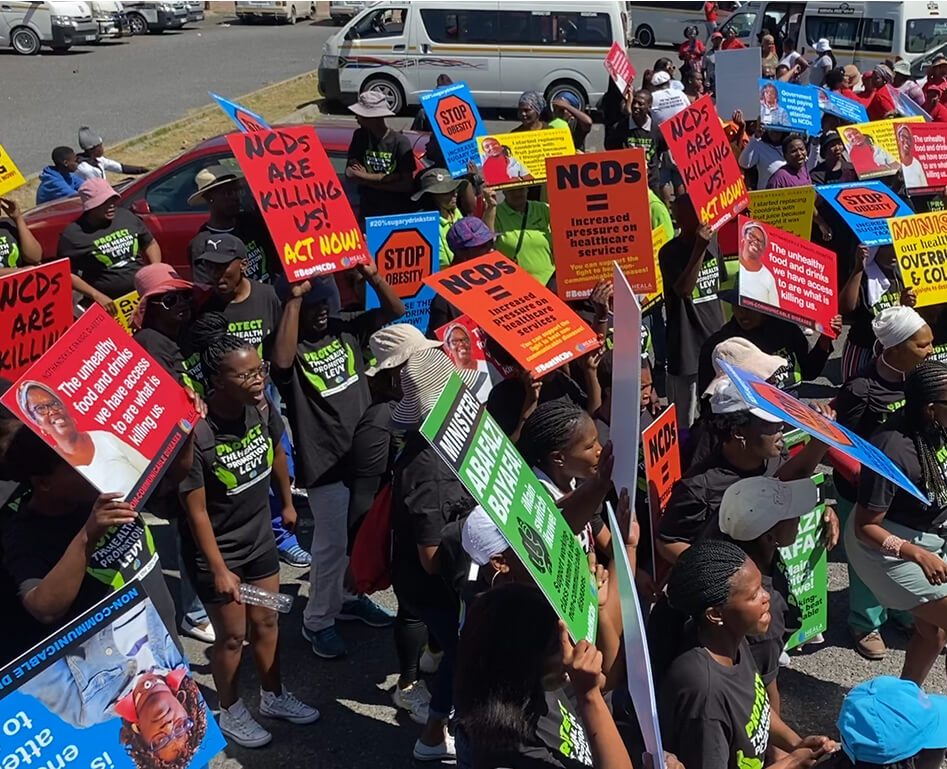
JOHANNESBURG, SOUTH AFRICA — Today, a broad coalition of public health advocates, civil society organisations including HEALA ( Healthy Living Alliance) launches “90 Days to Protect Our Health,” an intense public accountability campaign demanding that the Government and Department of Health (DoH)Minister of Health, immediately finalise and ratify South Africa’s stalled Front-of-Pack Warning Label (FoPWL) regulations (Regulation R3337).

The launch marks a strict 90-day countdown to 10 December 2026, the definitive deadline by which the National Department of Health must enforce these life-saving regulations. First published in April 2023, the draft regulations propose mandatory, easy-to-read front-of-pack warning triangles on ultra-processed foods high in sugar, salt, saturated fat, and artificial sweeteners, alongside tight restrictions on marketing junk food to children.

Yet, more than three years later, the regulations remain trapped in a state of perpetual draft form. Growing evidence indicates that commercial food industry lobby groups have weaponised institutional negotiation frameworks at the National Economic Development and Labour Council (Nedlac) to trap the policy in a cycle of endless delay. At the recent 31st Annual Summit, Deputy Minister of Labour, Minister Sibiya, told government, business and labour and civil society that talk without implementation will not change lives, this sentiment is echoed by HEALA. 

“South Africans have waited long enough to know what is truly in the food they feed their families,” says HEALA CEO, Nzama Mbalati. “We cannot allow Nedlac to become a stumbling block where public health regulations go to die. Industry pressure, commercial stalling tactics, and prolonged corporate debates must not be permitted to compromise a policy designed to curb South Africa’s catastrophic epidemic of lifestyle diseases, like diabetes, which has now become the number one killer disease in South Africa, surpassing HIV and TB,  obesity, and hypertension.”

The #ApproveFOPL campaign shifts the spotlight away from technical, bureaucratic arguments and directly onto government accountability, posing one clear question: “Government and DoH, will you protect South Africans’ right to know what is in their food, or will you side with big business on 10 December?”

Currently, consumers must navigate a wall of complex, un-understandable and technical nutritional tables on the back of food packaging just to see if a product is healthy. The proposed FOPL regulation replaces this confusion with instant, black warning triangles on the front of packages.

The campaign will escalate across four distinct phases over the next 90 days, utilizing an aggressive media rollout, investigative reporting on industry interference, and grassroots mobilisations by mothers, community healthcare workers, teachers, and youth activists across the country.

The coalition urges all South Africans to join the call, visit HEALA.org and sign a petition to the Minister demanding immediate action. Public health cannot be negotiated indefinitely. The clock is ticking, Tik Tok Tik Tok 

– ENDS –

For media enquiries and Interviews, please contact:

Mr. Neo Merafi

Maverick Brand Communications 

neo@maverickbrand.co.za

WhatsApp: 071 359 9738

OR 

Ms. Zukiswa Zimela 

Communications Manager- HEALA 

zukiswa(@)heala.org

WhatsApp: 074 521 0652

 Campaign Hashtags:#ApproveFOPL | #PublicHealthCannotWait | #EndTheDelay