UN Political Declaration on NCD’s, mental health and food justice reflects a diluted commitment to decisive action.

Press Statement 

For Immediate Release 

23 September 2025

Ahead of the United Nations High-Level Meeting on the Prevention and Control of Noncommunicable Diseases (NCDs) and the Promotion of Mental Health and Well-Being – 25 September 2025

As the world prepares for the Fourth UN High-Level Meeting on NCDs and Mental Health, the Food Justice Coalition is deeply concerned that the current draft of the Political Declaration reflects a diluted commitment to decisive action. While it acknowledges global ambitions to reduce premature deaths and promote mental well-being, it lacks bold, measurable, and enforceable commitments urgently needed to reverse the rising tide of NCDs and diet-related ill-health.

In 2021, NCDs caused an estimated 43 million deaths, many preventable. South Africa and other low and middle-income countries carry the heaviest burden, despite proven, cost-effective, interventions. Yet, the declaration weakens critical language on industry accountability and omits clear fiscal and policy mechanisms to tackle the commercial determinants of NCDs, especially sugar-sweetened beverages (SSB), ultra-processed foods, tobacco, and alcohol.

Taxes on harmful commodities are proven tools to reduce consumption and generate revenue for health systems. The latest advocacy report by the NCD Alliance,  a global alliance of organisations committed to fighting the rising tide of NCDs,  shows that financing essential NCD interventions requires at least 1.1–1.7% of gross national income, with up to 54% of costs allocated to essential medicines. Removing or softening commitments on taxation undermines governments’ ability to protect health and achieve financial protection for people living with NCDs.

Weak language signals weak resolve, emboldening powerful industries that profit from disease. The commercial drivers of NCDs, including aggressive marketing, price manipulation, and policy interference, cannot be addressed without binding, measurable fiscal and regulatory commitments.

Call to Action: South Africa and Member States Must Lead

The Food Justice Coalition calls on the Government of South Africa and all UN Member States to:


• Adopt binding regulations to reduce sugar, salt, and harmful chemicals in processed foods, alongside strict monitoring.


• Implement and scale up taxes on sugar-sweetened beverages, ultra-processed foods, tobacco, and alcohol, at levels proportional to their health harms.


• Ringfence revenues from these taxes to finance universal access to NCD prevention, essential medicines, and mental health services.


• Enact safeguards against industry interference, including full transparency on political donations and lobbying.


• Mandate independent monitoring of corporate products and marketing, with annual reviews against explicit targets on reducing harmful consumption and NCD mortality.


• Guarantee equitable access to nutritious food, mental health care, and primary health services, prioritising low-income and marginalised communities.


• Centre the voices of people living with NCDs in policy design, implementation, and evaluation.

Conclusion

The Political Declaration cannot be another missed opportunity. A bold and uncompromising stance is needed to confront the structural drivers of ill health, close the financing gap, and protect future generations. South Africa, with its constitutional right to health and progressive public health record is uniquely positioned to champion stronger language and insist on clear fiscal and accountability measures.

The Food Justice Coalition stands ready to work with government, civil society, and global partners to ensure that the UN High-Level Meeting delivers on its promise: a future where every person can exercise their right to health, free from the predatory practices of industries that profit from disease.

[Ends]

Issued by:

The Food Justice Coalition –

The Food Justice Coalition is a values-driven alliance of organisations committed to advancing food justice through collective action, mutual support, and shared leadership. 

For media enquiries please contact:

Zukiswa Zimela | HEALA | zukiswa@heala.org | 074521065

HEALA statement on Advertising Appeal Committee’s ruling on sugary drinks advert

HEALA is studying the decision by the Advertising Appeal Committee. It is important to note that the Committee does not state that our campaign advert is misleading due to warning the public against the harms of fizzy drinks and fruit juice, and expressly provided that it would not be misleading to warn against the consumption of “excessive sugary drinks” or “regular consumption of sugary drinks”.

The Committee also cites the World Health Organisation in this analysis, indicating even “a single serving (at least 250 ml) of commonly consumed sugary drinks per day” is to be avoided for health reasons. For a full synthesis on the harms of sodas and fruit juice, we direct interested persons to HEALA.org, where we provide an easy-to-read summary of the most up-to-date science as co-developed by several world-leading nutritionists, medical doctors, and public health specialists.

We would like to thank the Advertising Appeal Committee for its express recognition and commendation for the work that HEALA does to further the interests of public health.

For media interviews please contact

Zukiswa Zimela: Communications Manager HEALA

Zukiswa[at]heala.org

Announcement of the new HEALA CEO

The HEALA Board is pleased to announce the appointment of Mr Nzama Mbalati as its Chief Executive Officer (CEO) effective from the 1st of July 2024. Nzama has been serving with the organisation since April 2018 and has served as the Programmes Manager and recently the Interim CEO driving the overall HEALA strategy.

His professional experience encompasses over a decade in social justice, health, food and nutrition advocacy. He has a degree in Communication Science and Advance Project Management from the University of South Africa (UNISA) Graduate School of Business Leadership. He has significant experience in coalition building, community mobilisation, communication and management. He has spearheaded the conceptualisation of the food justice framing in South Africa’s food policy space and the establishment of HEALA Food Justice Coalition. Together with the HEALA team, Nzama has led the establishment of HEALA as a registered non-profit company two years ago.

During this time of transition, the HEALA Board appointed Nzama as Interim CEO for seven months from the 1st of December 2023. During this period, the Board provided important support to Nzama including regular engagement around his performance, in particular the transition from operational management to strategic oversight and strengthening of the organisational arrangements. A coach was appointed to support Nzama over the period to support his professional development. The Board also established a performance and human resource management process and is satisfied with the report of deliverables.

Please join us in congratulating Nzama on the appointment of his role and to wish him all the best and continued success.

Your sincerely,

Professor Scott Drimie HEALA Board Chairperson

HEALA Board Appoints Nzama Mbalati As Interim CEO

The HEALA Board is pleased to announce the appointment of Mr. Nzama Mbalati as its Interim CEO effective 1st December 2023. Mr Mbalati has been serving with the organisation since 2018 and has been a valuable member of HEALA as the Programmes Manager driving the Programmes Strategy. His professional experience encompasses over 17 years in social justice, health, food and nutrition advocacy.

Nzama is an experienced social justice activist with strengths in community and health systems strengthening, community mobilization, policy advocacy, lobbying, human rights and project management. Having worked in the social justice and public health space for over a decade, he is well-versed on issues of politics, policy, health, human rights, inequality and various other socio-economic issues facing the people of South Africa.

The term of the Interim CEO will be tied to the search of the next CEO. Over the next few months the Board will lead the search for the next CEO of HEALA with a passion for our vision and mission.

During this time of transition, we count on your continued support. Please join us in congratulating Mr Nzama Mbalati in this role and wishing him all the best and continued success.

Sincerely,

HEALA Board

Delays in increasing the Health Promotion Levy a danger to South Africans

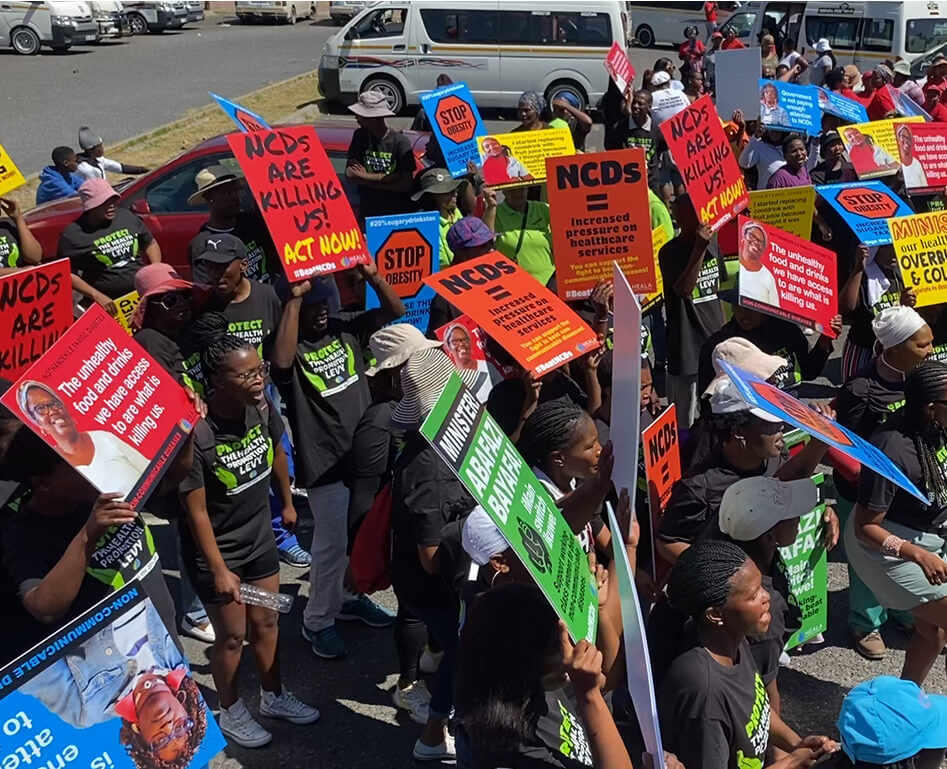
On World Diabetes Day the Healthy Living Alliance, HEALA, embarked on a day of action calling on the government to increase the Health Promotion Levy to the recommended 20% to reduce the over consumption of sugar sweetened beverages (SSB’s) and decrease the incidence of diabetes amongst South Africans. Concerned South Africans gathered outside the offices of the National Treasury demanding for the increase and calling for an expansion of the levy to include fruit juices.

New research points to an alarming trend of a dramatic increase in the consumption of sugar sweetened beverages (SSB’s) in Sub-Saharan region. The sub-Saharan Africa region had the highest increase in SSB consumption between 2005 and 2018 (2 serving/week increase) while in high income countries consumption decreased by about one serving/week.

Experts from Harvard School of Public Health found that those who drink between 1 and 2 cans of sugar sweetened beverages have a 26% greater chance of developing type two diabetes than those who limit their consumption.

There were huge differences in SSB intake between more vs. less educated adults in sub-Saharan Africa (more educated adults consumed over 4 weekly servings compared to less educated adults).

Taxes on sugary drinks have been shown to work in reducing the consumption of these drinks. A South African studyreleased in 2021, three years after the implementation of the Health Promotion Levy, a levy put in place to support of the Department of Health’s deliverables to decrease diabetes, obesity and other related diseases in South Africa, found that there “SSB taxes were associated with reduced sugary drink intake in a low-income population within a middle-income country”.

However, due to government’s inertia in increasing the tax to the recommended 20%, there is danger of eroding gains made from implementing the tax.

“It’s clear we have reached the cross roads as the country and key policy decision to significantly increase the sugar tax presents a unique opportunity to halt Noncommunicable disease rates that have doubled up in the past decade and raise much needed revenue on the fiscals in the dire strain,”  says Nzama Mbalati, Programmes Manager for HEALA.

Dr Dr Lungi Hobe, Chairperson at Rural Doctors Association of SA, says the cost of diabetes on the individual is high.

“This is a multi-organ disease. So it can affect any organ in someone’s body. The reason for that is that it primarily affects your vessels.  Your vessels, as we all know, exist in every organ of our body. You have veins in your eyes that may be affected by diabetes. Patients can end up with what we call diabetes retinopathy. Some patients end up with complete blindness just from diabetes,” Dr Hobe explains.

“You can also affect a vessel in your heart.  So patients with diabetes have a higher risk of having heart attacks, or what we call cardiac devastation. You can have problems with the vessels in your kidneys.  A lot of patients with diabetes will present with kidney failure or chronic kidney disease,” she adds.

Over 4 Million South Africans are currently living with the life altering illness, almost half of those are undiagnosed. The disease comes at a high personal and public cost. In 2018 experts estimated that the public sector costs of undiagnosed type 2 diabetes where R2,7bn. Considering the undiagnosed the number shoots up to a staggering R21.bn.

The country cannot afford any more delays to the increase of the levy. The costs of government’s inaction and pandering to the sugar industry are too high.

“We believe that government will make the right choice and not listen to the food and beverage industry who want to look out for their own interests,” concludes Mbalati.

OPINION: Let’s be upfront on front-of-pack labelling

By Nzama Mbalati and Zukiswa Zimela

It is really difficult to read food labels. What is trans-fat? How is it different from saturated fat? Why is sodium in milligrams instead of grams? Is it good for me?

That is, of course, if you even see the label on the back of the package.

On April 21, 2023, the National Department of Health published R3337, putting forward a draft regulation to introduce front-of-pack labelling in South Africa.

The draft regulation aims to provide easy-to-understand information on the front of packaged food to help consumers make healthy purchasing decisions.

This type of labelling has been incorporated successfully into several other countries and has been shown to help consumers better understand what they are eating.

The draft regulations also propose introducing restrictions on how foods can be marketed when those foods are deemed unhealthy.

The restrictions specifically aim to restrict techniques used to entice children to purchase and eat unhealthy food – an important measure as children are more vulnerable to persuasive marketing practices.

The draft regulation seems to be a no-brainer: more people will understand what is in food, and children will be less likely to be manipulated into making unhealthy eating decisions.

Especially in light of the worrying revelation early last week by Statistics South Africa that non-communicable diseases – diseases often associated with poor diets – have increased by 58 percent in the last two decades.

However, there has been staunch opposition from the food industry, and several red-herring arguments have been advanced.

We provide the following clarification to help the public understand the new proposed draft regulations.

Food producers will have fair use of their trademarks

The food industry argues that the restriction in the regulations aimed to remove misleading product descriptors “arbitrarily” deprive producers of their intellectual property rights.

First, the Trade Mark Act, the law regulating the protection of trademarks in South Africa, already contains a list of criteria limiting the use of trademarks, including allowing other laws to restrict trademarks or prescribing that marks which are confusing or misleading do not attract legal protection.

Second, food producers register multiple variations of their trademarks and will not face significant trade implications should a variation fall foul of the law.

As an example, we searched the Companies and Intellectual Property online database for trademarks affiliated with a popular soda brand in South Africa and found 60 different trademark results.

The regulations are deemed successful internationally The World Health Organization has called for front-of-pack labelling as a key consumer nutrition literacy intervention to promote healthy diets.

While it is very difficult to show how a policy intervention like a front-of-pack label can improve overall dietary choices, preliminary evidence exists (from Chile and more broadly), and strong evidence shows that the information-imparting objective is effective.

Additionally, the importance of the attached marketing restrictions to protect children has been proven, as studies show a strong link between unhealthy food marketing and childhood obesity.

Consumers should know that food contains ‘artificial sweeteners’

Evidence suggests that providing a warning label on excess sugar can lead consumers to unknowingly substitute sugar-sweetened beverages with alternative sweetened beverages (beverages containing artificial sweeteners).

The safety of artificial sweeteners is still debated.

The warning label is intended to be a consumer information intervention and warning consumers, especially parents, allows consumers to make a decision on appropriate artificial sweetener intake given the risk of allergic reaction, impact on diet for patients with diabetes, potential impact on long term food preferences and emerging evidence on the risk of cancer.

The label will not make it more difficult to import or export food

All countries have variations in food safety and labelling standards and require different procedures to meet local laws. There is a definite trend towards introducing front-of-pack labelling, and food producers seek regulatory harmonisation, endorsing FOPL policies to best achieve this goal.

The food industry will unfairly lose profits

Some food producers argue that they will lose profit because consumers will not buy foods with the warning labels – that is the point!

People will always eat – having people eat healthier foods should encourage food producers to make better alternatives available to the public. Corporate profits can never be more important than public health.

* Nzama Mbalati is the programmes manager at the Healthy Living Alliance (Heala).

* Zukiswa Zimela is the communications manager at Heala.

This oped was first published on IOL on the 9th of November 2023
South Africa can show BRICS leadership with a new sugar approach

South Africa blazed a trail as the first African country to legalise a tax on sugary drinks, making a bold stand on 1 April 2018. By implementing this pioneering move, we paved the way for a strategy that could reduce the consumption of sugar-sweetened beverages significantly.

Studies by the World Health Organization (WHO) show that a carefully designed tax, aimed at increasing the retail price by 20% or more, would result in proportional reductions in consumption, steering citizens towards healthier choices.

READ MORE: WE Can’t Rely On Food and Beverage Industry to Safeguard Our Health.  

Not long after South Africa’s groundbreaking action, other countries, including Botswana and Zambia, followed suit, implementing their own versions of the sugary drinks tax. However, the road to a healthier society has not been smooth. Many African nations have been slow to act, potentially because of resistance from the beverage industry, which has been fighting back vehemently against these new regulations.

South Africa’s courageous step may have set the stage for a broader transformation, sparking a debate on how to combat obesity and promote healthier living. But the struggle against industry pushback and the adaptation of these laws across the continent continues.

This opinion piece was published in the Daily Maverick on the 29th of August 2023

Click here to read the rest of the article.

Press Statement: Food and beverage companies are ‘cereal’ offenders when it comes to targeting children

New research demonstrates that child-directed marketing strategies are used on most South African breakfast cereals. 

“New research from University of the Western Cape, led by researcher Alice S. Khan, exposes how breakfast cereals, which directly market to children, have a lower nutritional value and 96% of the cereals studied had a nutritional health claim. There is an urgent need for regulations to restrict this predatory marketing and to introduce clear front-of-package warning labels on unhealthy products so consumers can make informed decisions,” says Nzama Mbalati Programmes Manager for HEALA.

The research shows that marketing and advertising is a key factor in promoting the consumption of ultra-processed products. Children are highly susceptible to these ads. Food and beverage advertising has remained unregulated even though children’s rights are guaranteed in the South African Constitution.

In this study, the researchers assessed the nutritional composition of 222 breakfast cereals, direct child marketing strategies (i.e., illustrations, characters, fantasy, role models), and indirect marketing to children’s parents (nutritional claims and health claims). Breakfast cereals with direct child marketing strategies had lower levels of protein and fibre and higher total sugar and carbohydrate content than those without direct marketing strategies.

HEALA is calling for the National Department of Health (NDoH) to ensure that there is strict regulation on the marketing of products with front of package warning labels, as this marketing has the potential to influence purchase and consumption of unhealthy products, and until now, has been highly pervasive and unregulated in South Africa. Research shows that mandatory restrictions are necessary to ensure that products do not have child-directed marketing. Promises made by the industry to self-regulate have not been effective in reducing targeted marketing to children.

South Africa is one of the few countries in the world that promotes peoples access to high-quality food in its Constitution. Section 27(1)(b) of the South African Constitution guarantees all the right to sufficient food and commits the state to the progressive realisation of this right. Additionally, Section 28(1)(c) states that every child has the right to basic nutrition, shelter, basic health care services and social services. Hence its crucial that the State guards against industry practices that seek to reverse the hard earn gains enshrined in our constitution.

Draft Regulation Relating to the Labelling and Advertising of Foodstuffs (R3337) furthers South Africa’s commitment to the right to food by regulating how unhealthy products are marketed to children and adults and through introducing front-of-package labels warning of high levels of sugar, salt and saturated fat. The comment period for Draft Regulation 3337 was recently extended until 21 September 2023, we suspect due to the lobbying efforts of the food and beverage industry to stall its implementation.

ENDS

About HEALA’s advocacy work in South Africa:
HEALA is a coalition of civil society organisations advocating for equitable access to affordable, nutritious food in South Africa by building a more just food system. Because government policy forms a crucial part of the South Africa’s food system, HEALA believes that hunger, food insecurity and malnutrition are policy choices.

HEALA advances the right to food by advocating for more just food systems in South Africa. We do this by acting as a platform for organisations and communities to organise around the realisation of the right to affordable and nutritious food. Through our campaigns, we help amplify the voices of people on the ground to ensure that they are heard by those in power at a local, provincial and national level.

HEALA’s vision is a South Africa in which all people have equitable access to healthy food to unlock their full potential.

For more information HEALA’s advocacy work, please visit: https://heala.org

Media Contact
Zukiswa Zimela, Communications Manager
zzimela@heala.org | 0745210652

Activists call for more restrictions on marketing of unhealthy foods and drinks to children

With one day to go before the 21 July closing of the public comment period for new draft legislation on mandatory food labelling and restrictions on marketing of unhealthy foods and drinks, the Healthy Living Alliance (Heala) is calling on government to strengthen the proposed marketing restrictions – specifically, to place tougher restrictions on advertising and marketing to children.

The new draft regulations, called R3337, include long-awaited, mandatory front-of-pack warning labels for foods high in added sugars, fats and salt, and on any product containing artificial (non-sugar) sweeteners, to reduce the risks of obesity and non-communicable diseases such as type 2 diabetes and cardiovascular disease.

The draft regulations also propose long-awaited restrictions on the marketing and advertising of foods and drinks to children, who are particularly vulnerable to the influences of marketing, and are often the targets of “aggressive food and beverage advertising campaigns”, Heala says.

Read the whole article here: https: Daily Maverick 

OP ED: Help protect your fellow South Africans against predatory food practices

The National Department of Health has released front-of-pack warning label regulations for public comment. South Africans need to participate in the process to ensure that we are all protected from profit-driven corporate activities promoting harmful goods and unhealthy food.

Growing up in the Eastern Cape, I remember eating foods prepared from start to finish in our home kitchen. Boarding school introduced me to packaged foods. And university introduced me to fast food. 

But I would never have imagined that this change was seeping into the food environment, with ultra-processed foods becoming the norm.

It is no wonder that the explosion in obesity rates and the rise in noncommunicable diseases in the Global South coincided with the proliferation of fast, convenient food.

Research shows that two in five women and one in nine men in South Africa are obese. Children don’t fare any better. The South African National Health and Nutrition Examination Survey found that South African children between the ages of 6-14 years have a combined overweight and obesity prevalence of 13.5%.

The idea is that we are being sold convenience and affordability. Little is said about the negatives: the rising rates of diabetes, heart disease and cancers.

To make them cheaper and more profitable, many of the ultra-processed foods we eat are loaded with additives such as sugars, salts and trans fats which wreak havoc on our bodies and put us at risk of preventable premature death, while we are armed with little more than impossible to understand back-of-pack nutrition labels.

To curb the ballooning burden of noncommunicable diseases, the World Health Organization recommends the implementation of evidence-based government-ledstrategies and policies to improve the food system and diet in the population.

One of these strategies is the use of stronger food regulations such as front-of-pack warning labels that are visible and consumers can understand at a glance. A deluge of research has found that large warning labels with a contrasted background for better noticeability, and the use of “excess” instead of “high in”, improve understanding of the nutritional content found in certain foods, leading to a change in people’s food-making choices for the better.

Fresh regulations

The National Department of Health has released front-of-pack warning label (FOPWL) regulations for public comment. South Africans need to participate in the process to ensure that we are all protected from profit-driven corporate activities promoting harmful goods and unhealthy food.

The newly published FOPWL and marketing draft regulation, R3337, will make it easier for all South African consumers to have clear information about the food we consume, empowering us to make better food choices. The regulations will also make it harder for major food organisations to market to children, who are vulnerable to the food industry’s predatory marketing practices.

Of course, the food industry could take a page out of big sugar’s playbook to block or water down the regulations, citing the cost to the economy caused by the implementation of front-of-pack warning labels and other effective public health policies. At the end of last year, the sugar industry used this tactic to bolster its calls for the scrapping of the Health Promotion Levy, a government policy aimed at reducing the consumption of sugar-sweetened beverages, which have been shown to have a negative effect on consumers’ health.

The tactic, used against a population suffering from hunger and poverty, is a low blow. The reality is that people should not have to choose between filling their stomachs in the short term and irreparably damaging their health in the long term.

We know that unless the food and beverage industry is forced to change, it is unlikely to. Experts from Priceless SA at the University of Witwatersrand School of Public Health found there is no evidence that voluntary actions by the food and beverage industry can safeguard public health. In fact, voluntary actions can delay the implementation of lifesaving interventions. Mandatory regulatory interventions are easier to monitor than self-regulation.

Contrary to the food and beverage industry’s claims about the cost to the economy, the costs of diseases such as diabetes, heart disease and some cancers are impossible to ignore. Disease itself has a cost, and for many South Africans, the cost of paying for healthcare and the inability to work due to illness takes food out of their mouths.

Researchers at Wits University crunched the numbers and found that “overweight and obesity are costing South Africa’s health system R33-billion a year”.

It is condescending to assume that poor people do not care about the quality of the food they eat. Researchers found that parents were more than keen to choose better food for their families, particularly if there was a sick person at home. What they needed was easy-to-understand information on which to base those choices, as outlined earlier.

It is true that warning labels alone won’t fix the entire problem of a profit-driven food environment, but it is a step in the right direction. Failure to act will result in more deaths and increased suffering.

We need your voice to ensure that the new front-of-pack warning label regulations are passed. Use this link to ask the National Department of Health to listen to YOU and pass the regulations. DM

Zukiswa Zimela is the communications manager at the Healthy Living Alliance (HEALA).This opinion piece was published in the Daily Maverick on the 16th of May 2023